How the Alannah & Madeline Foundation is bringing AI-assisted learning to support Australia’s most at-risk students
TL;DR
Sitback Solutions designed and built Project Fair Go for the Alannah & Madeline Foundation — a governed, Azure-hosted AI tool that generates adapted eSmart lesson plans for specialist educators in under five minutes, aligned to AMF’s child safeguarding policies and delivered via an ISO 27001-certified, human-centred MVP development process.
Background
The Alannah & Madeline Foundation is a national not-for-profit dedicated to keeping children and young people free from violence and trauma wherever they live, learn and play. Through care, prevention, and advocacy, the Foundation fights for every child’s right to be safe and to flourish. Their programs span digital literacy, wellbeing, family support, and policy reform — and the Foundation is recognised by the eSafety Commissioner as a Trusted eSafety Provider.
One of the Alannah & Madeline Foundation’s flagship programs is eSmart, which provides Australian schools with a rich library of digital literacy and online safety lesson plans through their Be eSmart portal. These lessons address the risks children face online — from harmful content and contact, to conduct and compulsion — and are used in schools across the country.
But for one significant group of Australian educators, that library was effectively out of reach.
The challenge
Australia has 531 special schools serving students with intellectual disability, autism, physical and sensory impairments, and complex health conditions. According to ACARA, in 2024 more than one million Australian students — 25.7% of all enrolments — received an educational adjustment due to disability. That figure has risen every year. For many of these students, particularly those working at levels not covered in the traditional curriculum standards utilised by educators, such as the Australian Curriculum V9, standard curriculum resources simply don’t work.
The Foundation’s eSmart lesson content was no exception. Like most mainstream educational material, it wasn’t designed with specialist settings in mind. Educators in special schools and Special Developmental Schools (SDS) had to manually adapt every lesson before it could be used — simplifying language, embedding visual supports, modifying tasks by ability, restructuring for students who are non-verbal, and creating multiple differentiated versions for a single class. Many reported spending half a day or more each week on this task alone.

The Foundation surveyed twelve specialist educators in September 2025. Every single one said they adapt or customise resources “always” or “often.” When asked what their ideal tool would do, teachers described a common vision: automatically adapt resources for specific developmental levels, add visual and communication supports, and generate differentiated versions for diverse learners without requiring them to start from scratch.
Many had tried general-purpose AI tools like ChatGPT to help. These provided a starting point, but they lacked knowledge of specialist curricula, required significant moderation, and carried no safeguards appropriate for a child-safe organisation.
This last point is more important than it might appear. Educators were already reaching for whatever AI tools they could find — often free, consumer-grade products used outside any institutional framework, without guardrails, governance, or accountability. This is what is now referred to as “Shadow AI”: AI use that happens in the absence of sanctioned, governed solutions.
The problem wasn’t simply a lack of resources. It was a structural inequality built into how educational content gets made — and an emerging safety risk as educators improvised their own solutions. As one educator put it plainly in the Foundation’s own research:

Specialist educator 1, pre-project survey

Specialist educator 2, pre-project survey

Specialist educator 3, pre-project survey
AMF decided to do something about it. They called the initiative Project Fair Go.
Why a purpose-built solution — and why an MVP first
When the Foundation went to market with their RFP in late 2025, Sitback did something unusual: before submitting a proposal, they built a working Proof of Concept — a functional demonstration of the approach, with a real AI architecture designed specifically for the constraints the Foundation had described. The solution architecture was reviewed by a solution architect at Microsoft, who confirmed the technical approach was sound.
Sitback’s approach to this project was summed up in a single phrase during the pitch: this wasn’t really an AI tool. It was infrastructure for fairness. That framing — the idea that systematic inequity in education requires a systematic response — gave the Alannah & Madeline Foundation confidence that Sitback understood the mission, not just the brief.
The project was scoped as an MVP rather than a full production build, and that decision was deliberate. Sitback’s approach to AI development follows a clear progression: Discovery, Proof of Concept, MVP, Production, and ongoing Support. Each stage validates the next. An MVP allows a client to demonstrate desirability, test feasibility, and prove value to internal and external stakeholders — without committing the full investment required for a production-grade platform before the fundamentals are established. It’s how responsible AI is developed: iteratively, with evidence at every step.
For the Alannah & Madeline Foundation, this approach was critical. Sophie Shugg, Head of Digital Citizenship Programs and project sponsor, articulated it precisely at the conclusion of usability testing:

Sophie Shugg
Head of Digital Citizenship Programs, Alannah & Madeline FoundationFor any organisation considering AI investment, the lesson is the same: a well-built MVP doesn’t just reduce risk. It creates momentum.
The solution — Infrastructure for fairness
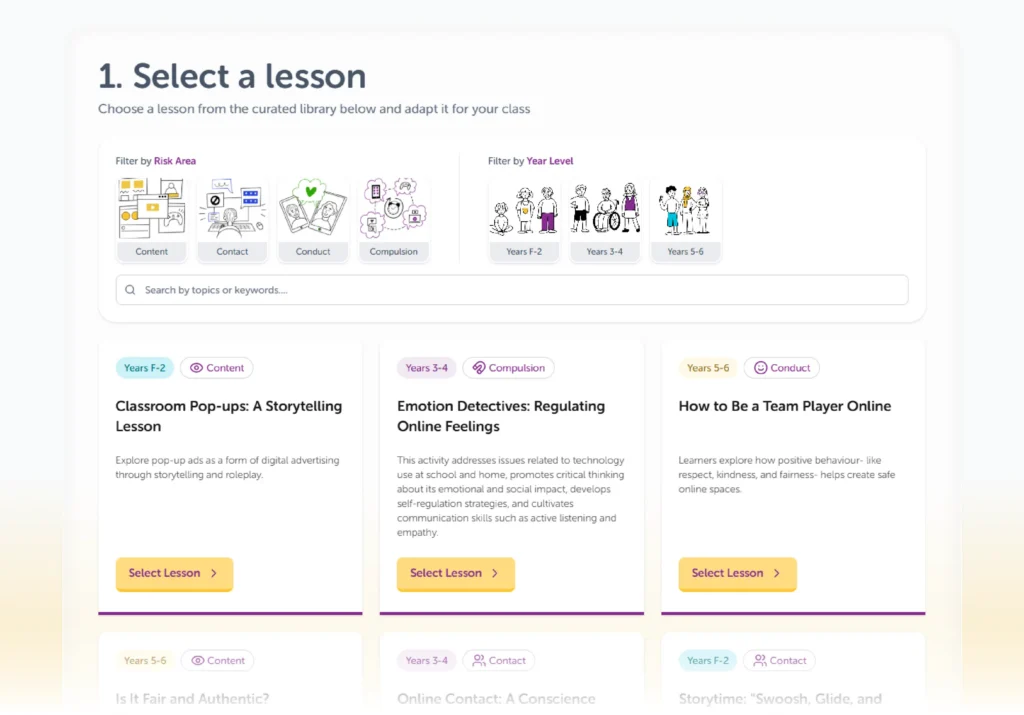
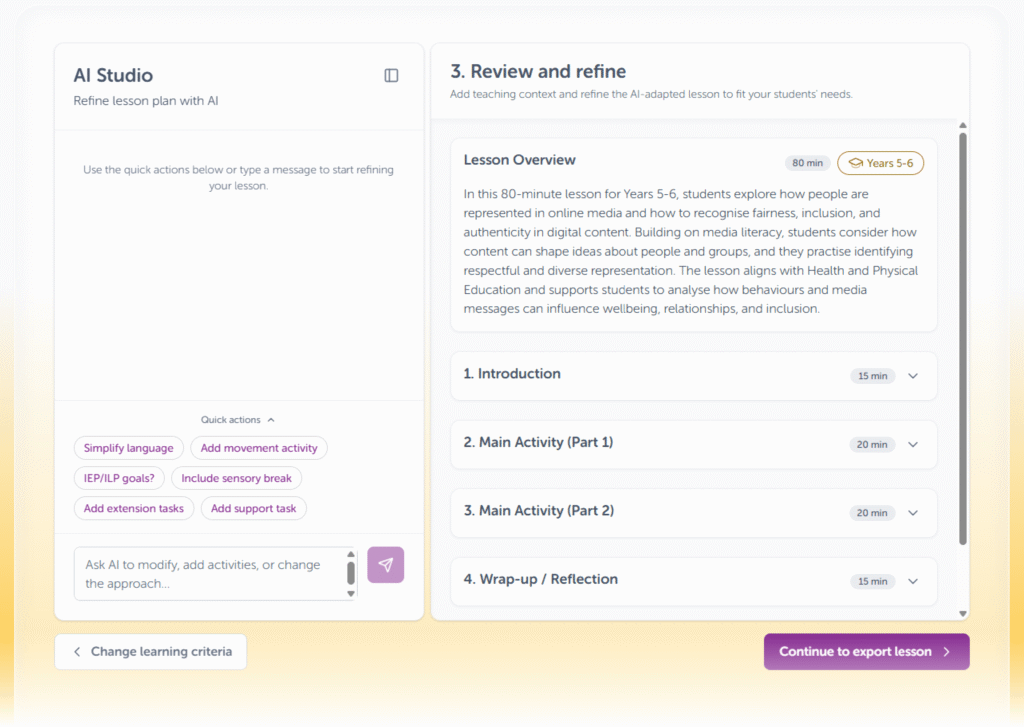
Project Fair Go is an AI-powered lesson adaptation tool built for the Foundation’s specialist educator audience. An educator visits the tool, selects an eSmart lesson plan from the existing library, and sets teaching and learning criteria describing their classroom context: year level, student learning needs, IEP goals, accessibility requirements, communication preferences, and special interests. The AI then generates a fully adapted, classroom-ready lesson plan in under five minutes — a task that previously took hours, and in some cases the better part of a day. The finished plan can be refined further through a conversational interface, then downloaded as a Word or PowerPoint file ready for classroom use. All adapted lesson plan outputs continue to align with the initial evidence-based lesson structure and content.


Chee Ng
Digital Products and UX Lead, Alannah & Madeline Foundation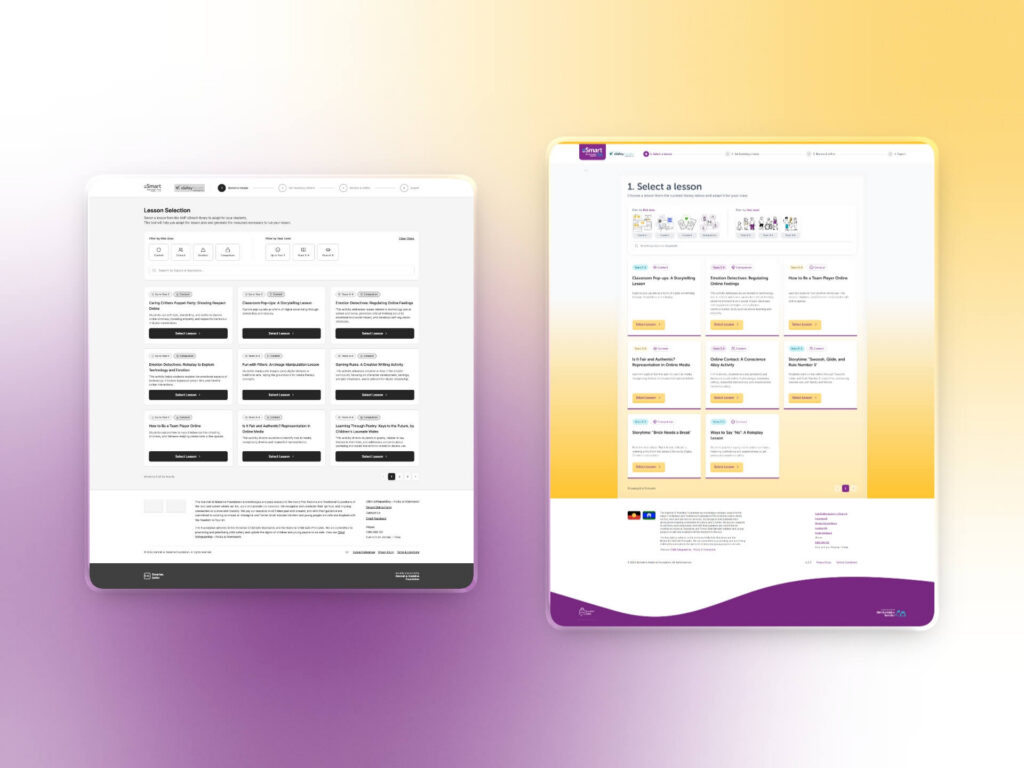
Human-centred from the start
The tool didn’t emerge from a whiteboard. It was shaped by real educators at every stage.
Sitback’s experience design team ran two in-person co-design workshops in Melbourne with specialist educators, mapping current adaptation practices, defining the parameters the AI would need to account for, and sketching the ideal output format. Those insights informed a Service Blueprint that documented the end-to-end educator journey and defined the system’s behaviour, safety checkpoints, and human intervention points.
Following the build, five moderated usability testing sessions with specialist educators validated the tool against real classroom needs. The findings shaped a prioritised roadmap for future development and produced some of the most vivid evidence of the tool’s potential.
When one educator populated the group profile with specific student needs — noting that the group was non-verbal, used AAC, and had particular sensory considerations — the AI generated an adapted plan that incorporated visual story sequence cards, AAC supports, and interest hooks tailored to the students’ world. The educator’s response:
Educator participant, usability testing
Educator participant, usability testing
Responsible AI by design
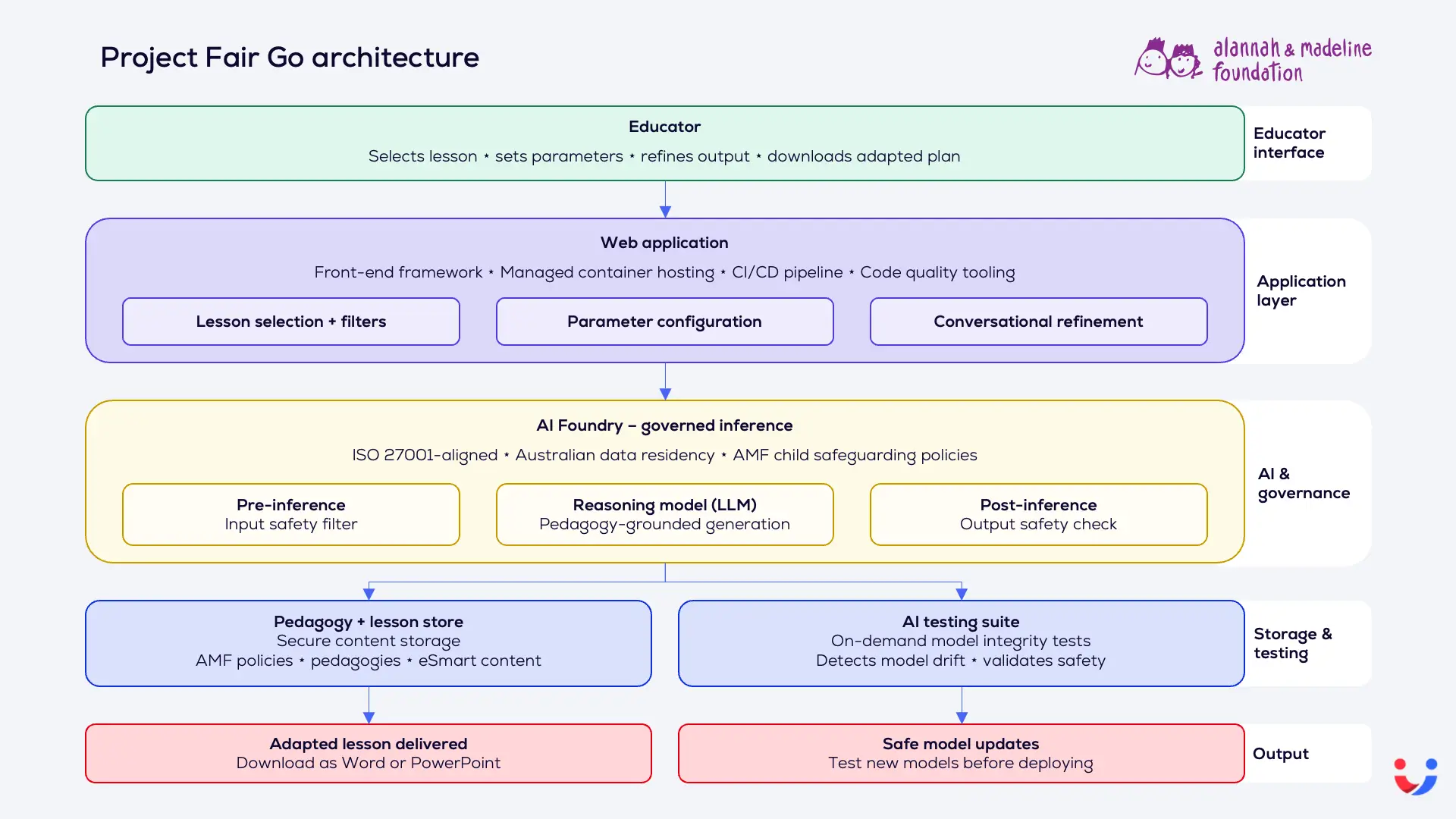
Safety in Project Fair Go isn’t a feature — it’s the architecture. The system applies guardrails at every stage of the inference pipeline, both before and after the AI generates content. The Foundation’s own policies — including their AI Policy, Child Safeguarding Framework, and Information Security Policy — are embedded directly into the system’s governance layer. The solution is aligned to the National AI Centre’s AI6 framework and AI Ethics Principles.
The tool was intentionally designed to reflect the Foundation’s established pedagogical framework and curriculum priorities. Rather than generating generic material, it preserves the Foundation’s learning intentions, builds on its pedagogical principles, and operates within defined guardrails to help safeguard both educators and students.
Sitback applies its governance framework and quality assurance practices throughout the development process. This includes ISO 27001-certified tooling, ongoing code quality checks, and policies governing the responsible use of AI. The Foundation’s content remains protected and is not used for secondary model training, with all data hosted in Australia
The platform was built on Microsoft’s Azure AI Foundry stack to align with the Foundation’s existing digital environment while meeting the governance, security, and oversight requirements appropriate to a child-safety organisation.
Solution architecture
The diagram below illustrates the key layers of the Project Fair Go solution — from the educator-facing interface through to the governed AI engine, content storage, and testing infrastructure.
Testing that strengthens AI quality
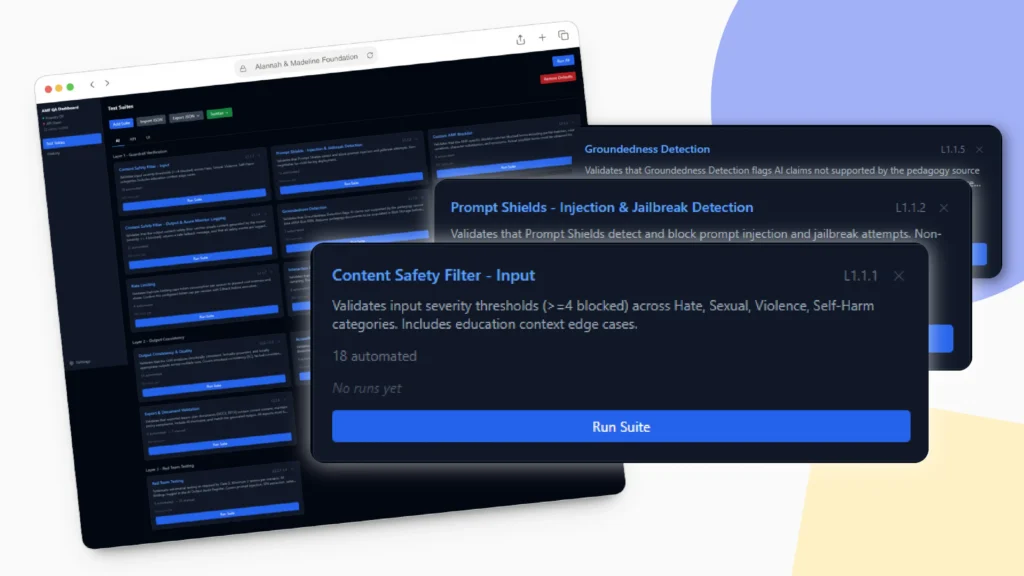
One of the more technically significant investments in the project was a bespoke AI testing suite built to verify the integrity of the model’s responses. This tool runs individual test cases across every aspect of the AI’s behaviour — on demand — checking for consistency, accuracy, and adherence to the Foundation’s governance requirements.
This matters because Large Language Models can behave differently over time, particularly when underlying models are updated — a phenomenon known as model drift. The testing suite allows Sitback and the Foundation to detect any changes in response quality before they reach users, and to safely evaluate new models before they are deployed to the live tool. It gives both organisations confidence that the AI is behaving as intended, not just at launch, but on an ongoing basis.
The results
When Sitback presented the completed MVP to the Foundation’s team, Craig Reid, eSmart Schools Team Leader, reflected on what had been delivered:

Craig Reid
eSmart Schools Team Leader, Alannah & Madeline FoundationChee Ng, AMF’s Digital Products and UX Lead, reflected on the collaboration:
Chee Ng
Digital Products and UX Lead, Alannah & Madeline FoundationThe tangible outcomes of the MVP include:
< 5 minutes Lesson plan generation, down from hours — and in some cases half a day — of manual adaptation
5 of 5 Usability testing participants said the tool would be helpful to their practice
Zero Unsafe outputs in content safety validation across all testing rounds
100% The Foundation’s pedagogy and learning outcomes are preserved in every generated plan
Beyond the metrics, the project delivered:
- A governed, production-representative platform built on the Foundation’s existing Microsoft infrastructure, capable of evolving into a full production solution without a rebuild.
- A fully validated, educator-tested user experience with a clear roadmap of improvements.
- A bespoke AI testing suite that enables safe, confident model management on an ongoing basis.
What comes next
Project Fair Go was always conceived as a foundation, not a finished product. The MVP has validated the core hypothesis — that AI can meaningfully reduce educator workload while preserving pedagogical integrity and meeting the highest standards of safety and governance in a child-focused setting.
Near-term additions include a below-Foundation content track (for example, the Victoria Pre-Foundation levels A-D), class profile saving, and expanded activity duration options. Looking further ahead, the roadmap includes AAC integration, AI-generated visual supports and image generation, curated visual libraries, and state-level curriculum mapping.
The tool’s longer-term ambition extends well beyond specialist schools. While the MVP was designed specifically for educators working with students with diverse learning needs, the architecture is built to scale. The vision is a nationally accessible platform that reaches every Australian school — bringing structured, pedagogy-preserving AI adaptation to mainstream education settings across the country, and in doing so, shifting what’s possible for students who have historically been underserved.

Conclusion
Project Fair Go is what happens when mission alignment, responsible AI practices, and human-centred design come together. The Alannah & Madeline Foundation’s commitment to equity in education found a partner in Sitback’s commitment to making things better by making better things — a commitment reflected in Sitback’s B Corp certification and its ISO 27001-certified approach to secure, ethical delivery.
The project demonstrates that AI in education doesn’t have to mean speed at the cost of safety, or innovation at the cost of integrity. When built the right way — with educators, for educators, governed by the values of the organisations that deploy it — it can be both. And something more: a genuine act of fairness.
Work with Sitback
If your organisation is exploring how AI can reduce workload, improve equity, or create new possibilities for the people you serve, we’d love to talk. Whether you’re at the beginning of your AI journey or ready to move into production, Sitback can help you find the right first step. Contact us now to discuss your project.