Helping NSW households and businesses unlock energy savings
2026 Australian Web Awards Finalist
Energy Savings Finder & Calculator by Sitback & NSW Climate and Energy Action is a Finalist in the 2026 Australian Web Awards in both the Government and Drupal categories.
The NSW Government is focused on helping households and businesses reduce energy costs while accelerating the state’s transition to a more sustainable future.
Through targeted rebates, programs and policy initiatives, the Department of Climate Change, Energy, the Environment and Water (DCCEEW) is working to make energy upgrades more accessible and more achievable for everyday people.
To support this mission, the Department sought to create practical digital tools that would:
- Help citizens understand which rebates they may be eligible for.
- Demonstrate realistic annual savings in clear dollar terms.
- Encourage informed decisions about energy upgrades.
The brief to Sitback was clear in ambition: design and deliver two connected digital tools that turn energy policy into meaningful, personalised guidance — and launch in line with ministerial commitments.

Challenge
This was not a simple “build a calculator” project.
The Department had already invested significantly in policy development and energy modelling. They understood in detail:
- How savings vary across climate zones.
- How appliance upgrades interact.
- How rebate eligibility differs by property type, concession status and user group.
What remained was the challenge of translating this complexity into an accessible, trustworthy digital experience that everyday citizens could confidently use.
Working closely with DCCEEW’s policy, digital and data teams, Sitback helped shape a solution capable of bringing this modelling to life through two interconnected tools:
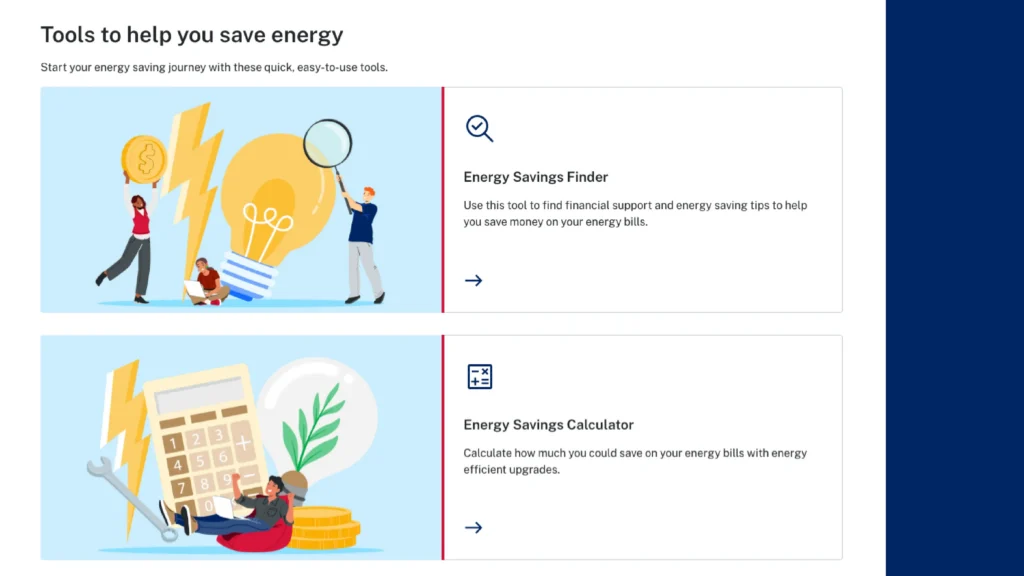
- Energy Savings Finder – to help users identify relevant NSW rebates and programs.
- Energy Savings Calculator – to estimate personalised annual savings based on real modelling data.
Behind that straightforward goal were significant technical and design challenges.
Complex conditional logic
Eligibility for energy programs depends on multiple factors, including:
- Property type.
- Ownership or rental status.
- Concession eligibility.
- Energy sources (gas, electricity, solar, battery).
- Residential vs business use.
Answers to one question often affect the relevance of several others. Designing the tools required careful collaboration between subject matter experts and engineers to ensure the system could support deep conditional branching while still remaining intuitive for users.
Large-scale modelling data
The Energy Savings Calculator is powered by a dataset representing more than 1.8 million modelled energy upgrade scenarios.
Rather than arriving as a finished dataset, this modelling was developed through close collaboration between DCCEEW’s data specialists and the Sitback engineering team.
As the product architecture evolved, both teams worked together to ensure the modelling could support a real-time interactive experience. Data assumptions, scenario structures and calculation rules were refined iteratively so that complex modelling could be translated into fast, user-facing calculations.
The resulting dataset maps combinations of:
- Home characteristics.
- Upgrade pathways.
- Climate zones.
- Residential and business savings values.
A key complexity was that savings are not simply additive. Removing one upgrade can change the savings profile of others.
To support this, the solution design and modelling approach were developed in tandem, enabling the calculator to dynamically recompute full scenarios as users explore different upgrade options.
Governance, compliance and time pressure
The project also needed to align with a number of government standards and delivery constraints.
The solution needed to:
- Align with the NSW Digital Design System.
- Meet accessibility requirements (WCAG compliance).
- Pass government security testing.
- Avoid collecting personally identifiable information from users.
All this needed to be delivered within a structured Plan > Build > Test > Deploy framework, in just a matter of months.
The solution
Working in partnership with DCCEEW’s digital and data teams, Sitback co-designed a unified, modular architecture capable of supporting both tools under a shared foundation.
Rather than building two isolated systems, we developed a consolidated Drupal module enabling shared infrastructure with tool-specific logic layered on top.
This approach ensured:
- Reuse of core survey components.
- Shared token-based result persistence.
- Shared email delivery infrastructure.
- A scalable platform for future enhancements.
The modelling and policy expertise sat within DCCEEW, while Sitback contributed experience design and engineering capability. Throughout the project, both teams worked closely together to translate complex modelling assumptions into clear, defensible calculations that could operate in real time.
Energy savings finder
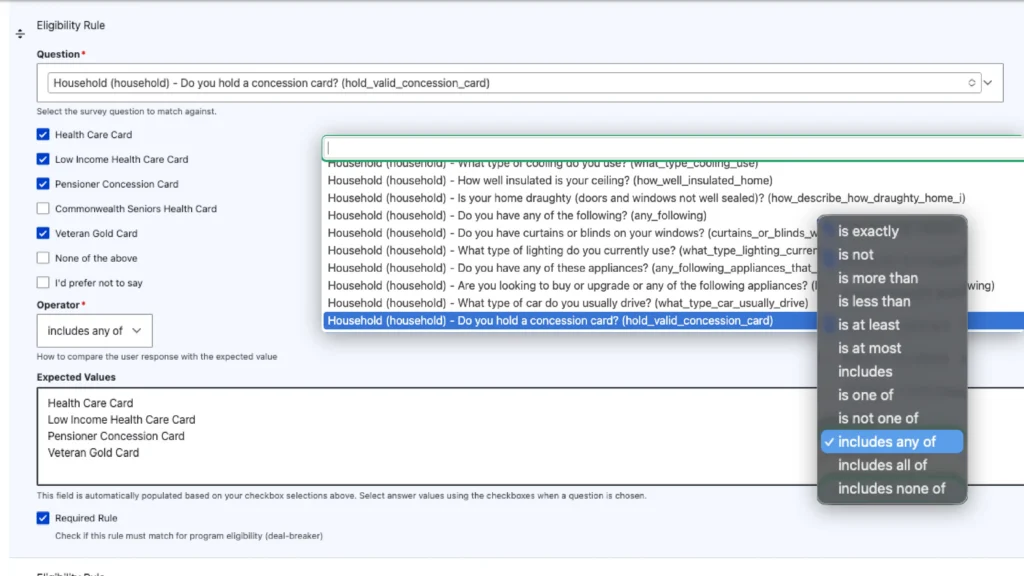
The Energy Savings Finder guides users through a conditional survey and surfaces eligible NSW energy programs and tailored energy-saving tips.
For users, the experience feels simple and conversational.
Behind the scenes, it includes:
- A custom rule evaluation engine built in Drupal.
- Editor-managed eligibility logic.
- Drag-and-drop question ordering.
- Nested conditional question flows.
- Taxonomy-driven energy tips linked to specific responses.
- Token-based results with configurable expiry.
Importantly, the platform was designed so that DCCEEW teams can update rebate programs, adjust eligibility logic, modify question flows, and preview and test rule combinations, all without requiring developer involvement.
This ensures the tool can easily evolve as policies change.
Energy savings calculator
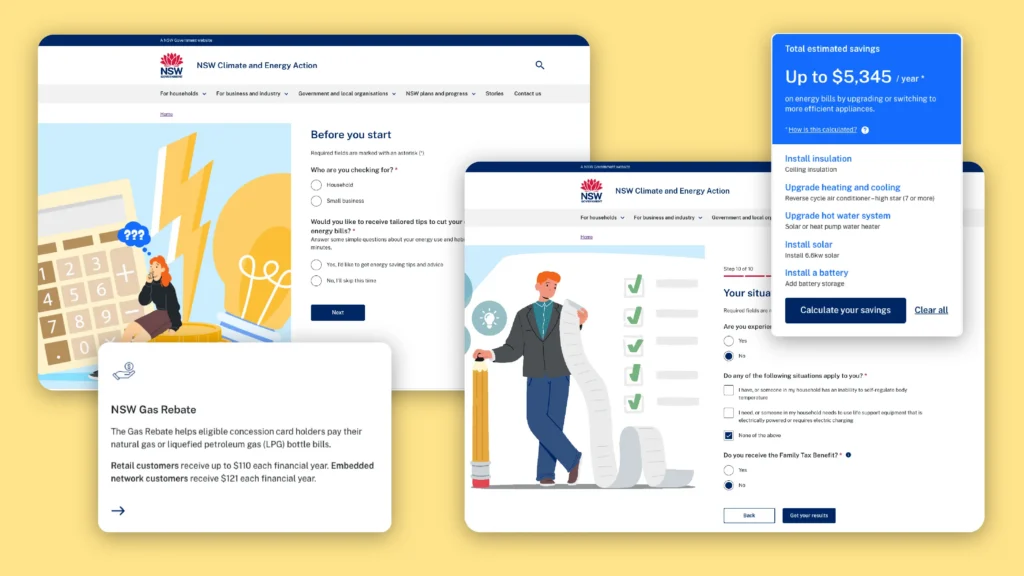
The Energy Savings Calculator extends the shared survey infrastructure and introduces a modelling layer capable of processing complex scenario logic.
Key capabilities include:
- Climate zone taxonomy and postcode range mapping.
- Upgrade pathways that calculate different savings depending on a user’s climate zone.
- Residential and business savings values.
- Conflict exclusion logic to prevent incompatible upgrades.
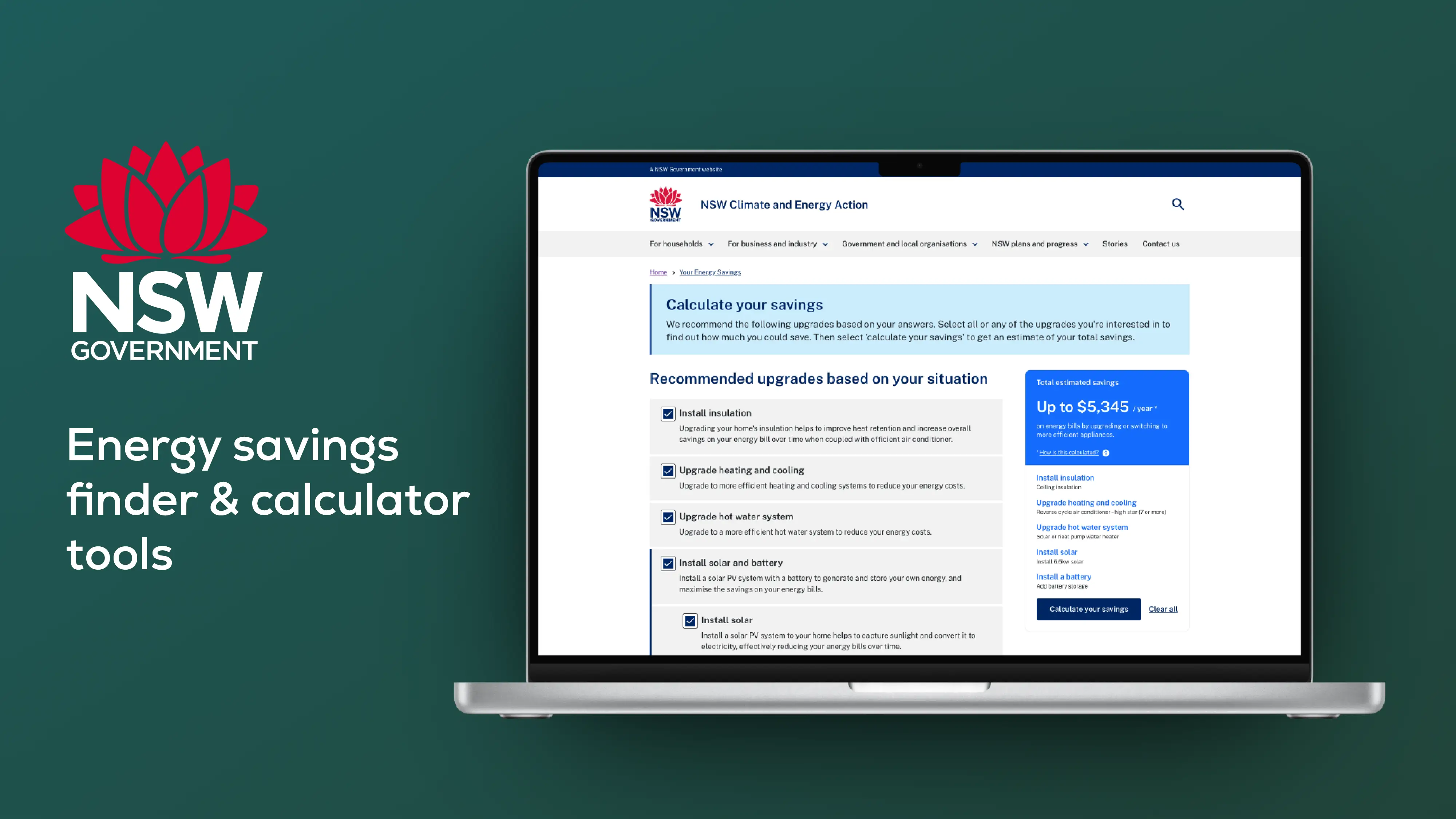
- Real-time recalculation when users toggle upgrade options.
When a user selects or removes an upgrade, the system recalculates the full scenario, not just a single line item.
The result is:
- Clear annual dollar savings.
- Itemised upgrade breakdowns.
- A defensible, data-backed estimate.
All delivered through a fast, mobile-friendly React interface.
Built for government, designed for people
Both tools were delivered using a headless Drupal + React architecture, enabling:
- Seamless integration with the broader Energy & Climate website.
- Cross-site navigation synchronisation.
- Secure CI/CD deployment pipelines.
- Structured testing and business-led UAT.
Accessibility and usability were prioritised from the outset. Throughout the project, Sitback worked closely with DCCEEW teams to ensure the tools met government accessibility standards while remaining approachable and easy to follow for a wide range of users.
Despite the technical depth, the user experience focuses on one simple, motivating concept: clear dollar savings.
Results
The Energy Savings Finder and Calculator launched successfully in line with ministerial expectations.
The tools now enable NSW households and businesses to:
- Discover relevant energy rebates.
- Understand realistic annual savings.
- Compare upgrade pathways.
- Revisit results via secure tokenised links.
- Make informed decisions with confidence.
Internally, the Department now has:
- A configurable rules engine for rebate eligibility.
- A scalable modelling platform for savings calculations.
- A foundation for ongoing analytics and optimisation.
- A reusable architectural pattern for future decision-support tools.
Why this work matters
Government policy and modelling often live in spreadsheets, internal systems and technical documentation.
This project demonstrates how that complexity can be transformed into intuitive digital services: transparent decision-support tools, built on scalable platforms, owned by internal teams
Through close collaboration between DCCEEW’s policy, modelling, communications, and digital teams, and Sitback’s experience design and engineering specialists, detailed modelling data has been translated into practical decision-support tools that citizens can easily understand and act on.
The result is a scalable digital platform that helps households and businesses make informed choices about energy upgrades while supporting the state’s broader sustainability goals.
Empowering people to act
Whether you’re encouraging responsible behaviour, promoting sustainability, or guiding users through complex eligibility pathways, the right digital tool can make all the difference.
We help organisations design interactive services that build trust, clarity and confidence — even when the logic underneath is anything but simple.
Let’s talk about your next digital service.